

Global growth remains relatively resilient, with IMF raising its 2025 world growth forecast to 3.2% (from 3.0%) in its October outlook. However, the IMF attributes much of this momentum to temporary factors like front loaded trade and investment activity rather than enduring structural strength.
The Fed cut rates by 25bp to 3.75-4.00% in its October meeting, a second straight cut and on expected lines. It also announced it will end Quantitative Tightening from 1st Dec 2025 to ease liquidity pressures. However, inflation remains elevated but stable, which gave the Fed some room to support a weakening labor market. The Fed is likely to delay or skip another cut in Dec 25, given Powell’s cautious tone and internal uncertainty.
India stands at a crucial juncture in shaping its economic and geopolitical future through self-determination. Over the past six months, the country has faced several adverse developments, such as the US tariffs, global geopolitical headwinds, and a kinetic war. Nevertheless, Indian policymakers have chosen to respond with a ‘resolve to reform’, turning adversities into opportunities to lay the ground for much stronger, long-term economic outcomes.
India’s growth trajectory has surprised on the upside, with Q1’26 GDP growth at 7.8% (versus consensus of 6.7%). Supported by above normal monsoons, FY26 GDP is now projected to grow at 6.8% (up from 6.5%), with the near-term outlook bolstered by solid high frequency indicators and post-GST cut demand recovery. RBI’s front loaded 100 bps rate cut and ample liquidity are aimed at reinforcing transmission, while inflation has moderated – helped by easing food prices and the pass through of GST cuts.
Though the RBI has maintained status quo in October but they have adopted a pro-growth, dovish tone, lowering its inflation forecast to 2.6% (from 3.1%) and raising its GDP forecast to 6.8% (from 6.5%), leaving scope for 25 bps rate cut in December if growth momentum warrants it.
Indian markets have been flattish from the past three months, despite global headwinds and 85000 Cr selling by FIIs. In a market seeking clear direction amid the tug-of-war between geopolitical wrangling, divergent corporate commentary and resolute steps taken by the Indian government /policymakers to prop up demand, we notice a reason for optimism.
A better earnings cycle, decent valuations (Nifty 12mth forward PE at 20.6x vs. long period average of 20.7x), and a base of underperformance (Nifty down 8% YoY vs +16%/+15% performance for MSCI EM/S&P 500 in the past year) set the stage for potential up-move in market.
Over 3500 companies have reported the results, and the trends are now fairly representative. And the numbers reinforce just how broad the recovery has become. Aggregate revenues have risen 8.2% year-on-year, while EBITDA and PAT climbed 14.1% and 16.0%, respectively.
The overall Q2’26 corporate earnings growth was driven by Telecom, Automotive, Banking & Finance, Metals, Healthcare, Energy, Cement and Capital Goods.
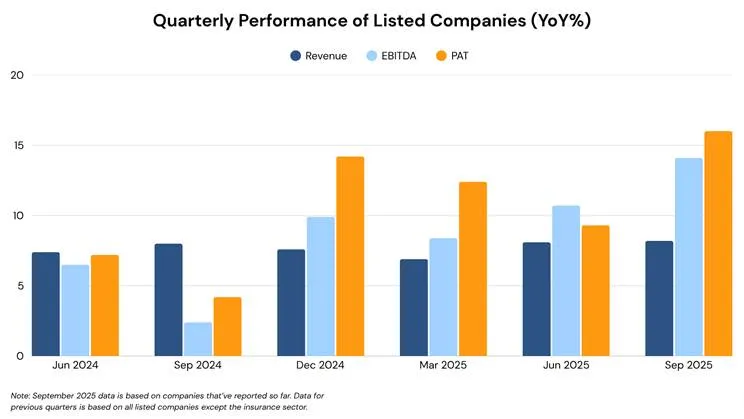
The earnings cycle is bottoming out, with growth accelerating into double digits. Although Indian equities have registered a lacklustre performance over the past one year, we continue to emphasize that the Indian markets now appear much healthier compared to last year. We believe that the cavalry of measures by the government will help reset the trajectory of corporate earnings, as domestic reforms are expected to continue. Additionally, any resolution of the tariff stalemate will be a key external catalyst, in our opinion.
Equity markets have been experiencing both time and price corrections from the highs reached in Sept last year. The pain in broader markets can be seen from the below table:
| Filters | Count | % |
| BSE Small-Cap (Total no. of stocks) | 1225 | |
| Positive returns | 425 | 35% |
| Negative returns | 800 | 65% |
Of the above 800 stocks delivering negative returns, almost 50% i.e. 395 stocks are down by more than 20%.
These are challenging times for most investors. While Gold is up ~30% YTD and the Nifty is trading near its 52-week high (largely driven by a handful of heavyweights), broader markets are not performing. Investors are understandably restless.
However, this very process is what keeps the market healthy and strong in the long run. It shakes out excessive speculation, removes froth, and brings stocks back to fair and sustainable valuations — exactly what a mature market needs from time to time.
What are we doing? – We had shifted to a few large-cap names during the end of last year as valuations in small and mid-caps were looking very high. However, post the correction/consolidation phase that we are witnessing since the last 1 year, we have begun the process of exiting from a few of such large-cap names, and use the funds generated to add to companies in the small and mid-cap segment where valuations have become attractive.
Our mantra remains the same:
“Stay focused, stay invested in quality, keep calm, and let time and compounding do the heavy lifting.”